How I Use BibGenie for Literature Reading and Research Notes
My research workflow with the Zotero AI plugin BibGenie: search papers, read critically, verify sources, compare studies, discover literature, and save research notes.
In a literature review, reading a new paper is only part of the work. More often, I remember a paper addressing an important question but cannot immediately find it; several studies use similar terms while evaluating different things; or a plausible summary turns out to have omitted a crucial qualification when I return to the source.
These are the tasks I want a Zotero AI plugin to help with: working through specific papers, research questions, and evidence. For me, BibGenie's value is in keeping questions, retrieval, and source verification within the same Zotero environment, so that an answer can become the starting point for further reading.
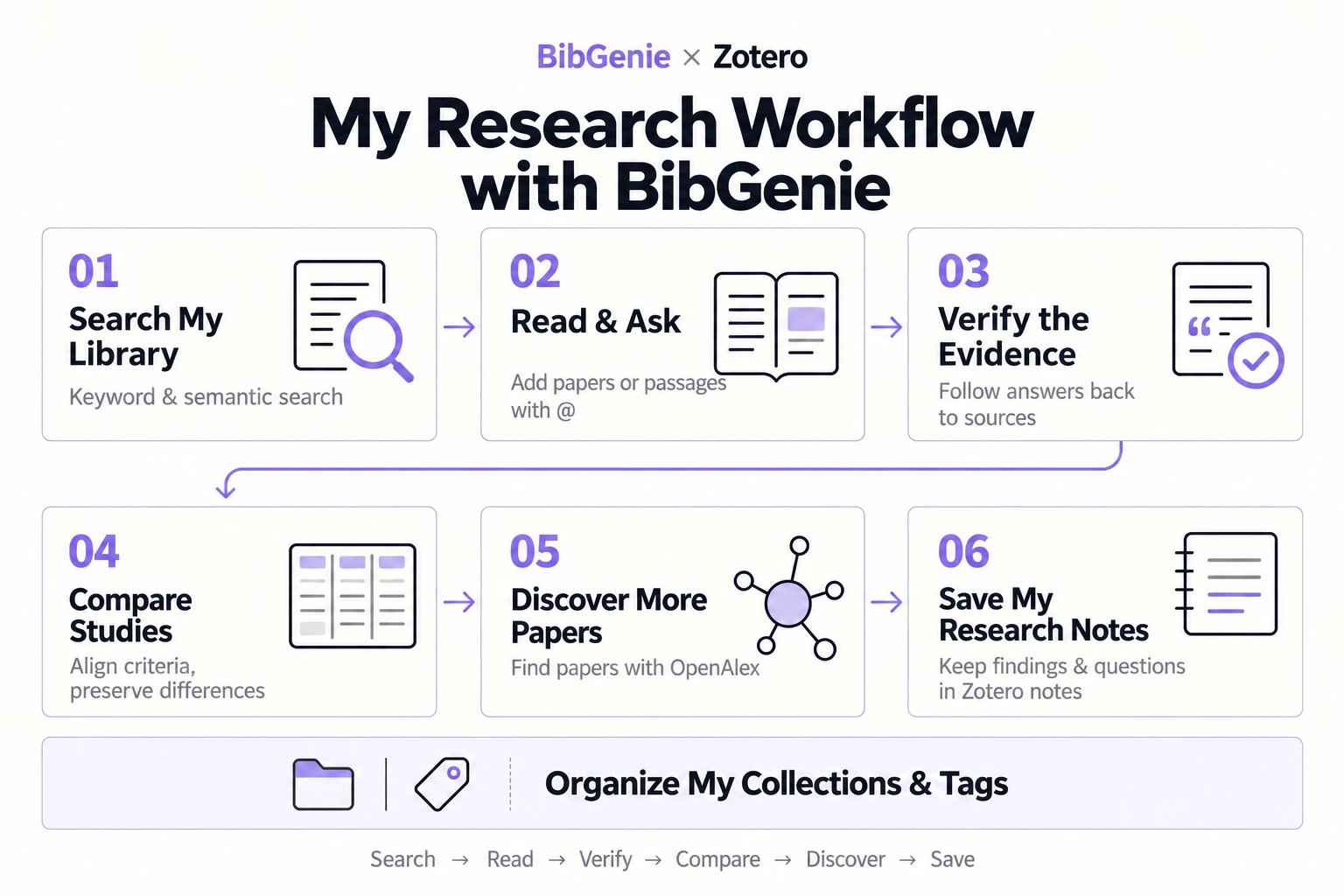
From a research question to reading notes; collections and tags are maintained separately as the library grows.
About this article
Written by the BibGenie team, this article presents the workflow from a team member's research perspective. The English version is the source text for translations. Evaluating answer faithfulness in retrieval-augmented generation is the running example; adapt the prompts to your own project. The examples do not report a completed research experiment or assume particular search results or findings.
1. Start with a research question and find papers I already have
When exploring a topic, I usually begin with the material already in Zotero. Here, the question is: How do retrieval-augmented generation (RAG) systems evaluate whether an answer is supported by the retrieved evidence?
Searching for faithfulness will find some papers, but related studies may use groundedness, attribution, or citation correctness. These terms are not necessarily equivalent, and relevant work may use different vocabulary. I therefore combine keyword and semantic search to identify candidate papers, then check how each relates to the question.
First, search my Zotero library for papers relevant to this question:
How do RAG systems evaluate whether generated answers are supported by retrieved evidence?

Combine keyword and semantic search. Consider faithfulness, groundedness,
attribution, and citation correctness, without assuming they mean the same thing.

List titles, years, and relevance based on titles and abstracts.
Identify information drawn from abstracts; do not present it as a verified full-text finding.
Search saved material only. Do not search external sources or modify my library.
At this point, I want a shortlist for reading. I check abstracts to distinguish factual correctness, consistency with supplied evidence, and the correctness of citations. Without that distinction, later comparisons may lack a common basis.
An automatically updated semantic index
BibGenie automatically builds and updates the semantic index, normally without manual management, so I can search around a research question directly. The index primarily uses item titles and abstracts to find thematically related papers with different wording; it is not semantic search over PDF full texts. I treat results as candidates and read the full text before judging methods or findings. See Semantic Index for the mechanism.
2. Add specific papers to the conversation, then examine methods and findings
Once I have chosen a paper, I type a space followed by @ in BibGenie's input box, enter its title, and select the matching result. The paper appears as a context block. I can then ask a question or add more papers and notes.
There is no need to open the Reader first. To discuss methods or experimental results, I make sure the selected item has readable full text attached. If only metadata such as the title and abstract is available, I limit the question to what that material can support. See Add Context for other ways to add material.
Rather than requesting a literature review immediately, I first unpack the logic of one study: its question, what the method evaluates, which findings the experiments support, and its limitations.
Using the full text of the paper I added, summarize:
1. The research question and how the authors define answer faithfulness or related concepts;
2. The unit of evaluation: an entire answer, sentence, factual claim, or citation;
3. The evidence used, annotation procedures, and evaluation metrics;
4. The experimental setup and main findings;
5. Limitations explicitly discussed by the authors.

Provide source citations for key statements so I can verify them.
Separate the authors' conclusions from your interpretation.
Mark anything the material does not specify as "Not specified."
This outline gives my reading a structure. I then ask about details that affect interpretation. For example, if a metric uses retrieved context as its reference, I check whether it also evaluates the correctness of that context. If it does not, the metric cannot by itself guarantee an answer's overall factual correctness.
For definitions, explanations near equations, or experimental details, I select the relevant passage in the Reader and use Add to Chat before asking. Adding a paper with @ supports discussion of the study as a whole; selecting a passage narrows the question to a specific piece of text. I use both during the same reading session.
3. Follow citations to the source and check whether the answer holds
When reading an AI summary, I focus on whether its key claims are supported by the original material. Before adopting a definition, result, or methodological limitation in my notes, I return to the source.
BibGenie provides source citations where applicable. Document citations with valid location information can take me back to the material and the relevant passage. Evidence citations serve a different purpose from links to Zotero items, attachments, or notes. Object links help me continue working, but a clickable paper title does not, on its own, establish evidence for an adjacent claim.
I check the following:
| What I check | Questions I ask |
|---|---|
| Definitions | Does the answer preserve the authors' qualifications and distinguish related terms? |
| Experimental results | Do the values, datasets, baselines, and experimental conditions match? |
| Methodological limitations | Is this an explicitly reported limitation or an AI inference? |
| Synthesis | Does the source support the judgment, or are additional sources needed? |
If an answer conflates different questions, I ask for a correction:
Recheck the definition at the cited passage.
Does it concern consistency with the supplied context, or factual correctness in the real world?
Explain the distinction using the source and revise your earlier summary accordingly.
Withdraw any unsupported claim, or clearly leave it as a question to verify.
A citation provides a path to the source; I still need to check whether that source supports the answer. For supported source types and navigation, see BibGenie Citations and PDF Paragraph Citations.
4. Compare studies using a shared set of criteria
After reading several key papers, I add their attachments and my existing notes to the same conversation for comparison.
The common pitfall is treating superficially similar results as directly comparable. Two papers may report scores while using different units of evaluation, evidence scopes, and datasets. A table organizes the material; it does not remove those differences in study design.
I specify comparison criteria first and leave room for "Not applicable" and "Not reported."
Using only the papers and reading notes I added, compare their evaluation designs.

Table columns: paper, concept definition, unit of evaluation, evidence source,
annotation or judgment procedure, datasets, main limitations, and source citations.

Use "Not reported" for missing information and "Not applicable" where appropriate.
Do not fill gaps or directly rank scores from different datasets or experimental settings.

After the table, list:
1. Commonalities supported by the available material;
2. Aspects that cannot yet be compared directly;
3. Questions I need to investigate in the full texts.
I verify cells that could affect my interpretation before forming a synthesis. If only an abstract or notes are available for a paper, that limitation should remain explicit in the comparison.
In my reading notes, I also distinguish what the authors report, how the AI summarizes it, and my own interpretation. When drafting a review later, I can revisit the evidence instead of treating a polished summary as a final conclusion.
5. Use OpenAlex to extend the search beyond my library
My local library represents material I have collected, not all research on a topic. After an initial reading, I use OpenAlex to find recent papers and explore citation relationships around relevant seed papers.
I explicitly ask for local and external results to remain separate. Finding a scholarly record is not the same as having read the paper.
Use OpenAlex to find additional research on evaluating answer faithfulness in RAG.
Start with at most 10 candidate records published since 2025.

List titles, years, publication venues or sources, and DOIs or other available identifiers.
Explain relevance based on available metadata; flag insufficient information.

Distinguish these records from the Zotero papers retrieved in this conversation.
Identify duplicates you can confirm, and separately list uncertain matches.
Do not import anything yet.
For promising papers, I ask about works that cite them, works they reference, or related records. Citation counts can guide exploration, but I do not use them alone to judge quality or reading priority.
OpenAlex primarily supplies scholarly metadata and citation relationships. Assessing whether a method fits my project still requires obtaining and reading the full text. After checking titles, DOIs, and scope, I decide which candidates to import into Zotero and continue the reading and verification process.
This is exploratory search. A systematic review still needs appropriate database selection, search strategies, inclusion and exclusion criteria, and search records. A single natural-language query is not a complete, reproducible systematic search. See OpenAlex Research for the feature's scope.
6. Save findings and research progress as Zotero notes
At the end of a reading session, I want more than a chat history. I want a note that lets me resume the work: what is established, what needs verification, and what to read next.
I ask BibGenie to organize the discussion, then review the content before saving. A note about one paper can be a child note attached to that item. Cross-paper comparisons and project progress are better suited to standalone notes, so that a synthesis does not appear to originate from a single paper.
Turn our discussion of RAG answer faithfulness into a research progress note.

Include:
1. The current question and material actually used in this session;
2. Findings checked against the original sources, with citations;
3. Tentative interpretations and unresolved disagreements;
4. Questions to verify and reading tasks for the next session.

Do not automatically label discussed content as "Verified."
Do not describe OpenAlex candidates as papers we have read in full.
Show the draft first; do not save it yet.
After reviewing and revising, I can ask: "Save the progress note above as a standalone Zotero note titled 'RAG Answer Faithfulness: Reading Progress.' Do not attach it to a paper." For a single-paper summary, I specify the intended parent item.
Alternatively, Save as Note on the last AI text response saves that response. For a long conversation, I first request a consolidated note. After saving, I check its location, source links, and tables in Zotero to ensure it works as a research record. See Save as Note for both methods and how parent items are handled.
When returning to the project, I can add the progress note to a new conversation with @, alongside newly read papers. Unresolved questions, earlier judgments, and new material can then be considered together.
7. Revisit collections and tags as the library grows
As papers accumulate, collections created at different stages may overlap, synonymous tags may use different spellings, and an earlier classification may no longer reflect my research question. For example, imported papers might use both RAG and retrieval-augmented generation; whether to merge those tags depends on my organizational practice.
I use BibGenie's library organization capabilities to inspect the existing structure and suggest changes. Its built-in Library Management skill can read collections, tags, and item information and assist with organization. I describe the goal in natural language without manually switching to a skill page.
My priority is to preserve a useful existing structure while addressing specific inconsistencies, rather than rebuilding the classification each time.
Inspect the papers in my current project collection, their existing tags,
and their collection memberships.

Propose a limited organization plan:
1. Identify potentially synonymous tags and differences in capitalization or spelling;
2. List proposed standardized names, affected item counts, and reasons;
3. Prefer existing collections when suggesting suitable subcollections for unfiled papers;
4. List uncertain cases separately rather than forcing a classification.

Do not assume similar names mean the same thing.
Show the plan first. Do not make changes, delete items, or overwrite metadata.
After review, I specify the changes to execute: for example, unifying confirmed synonymous tags, or adding selected papers to an existing subcollection while retaining their other memberships. When write approval is requested, I inspect the exact operation and affected items, then check the result in Zotero.
I handle missing DOIs, abstracts, and other fields separately, rather than combining collection changes, tag merges, and metadata revisions in one broad operation. See Library Management for capabilities and boundaries.
Research habits I keep
Throughout this workflow, I treat BibGenie's output as research material to examine and revise. Whether I adopt a judgment depends on the evidence, study design, and my project's requirements.
I keep these habits:
- Define the material in scope. Specify a selected passage, attachment, collection, or external search. Confirm readable full text before asking full-text questions.
- Preserve uncertainty. Do not ask the model to fill in "Not reported," insufficient evidence, or non-comparable results merely to produce a complete answer.
- Verify judgments I intend to use. Especially definitions, experimental data, limitations, and cross-paper synthesis.
- Separate evidence from interpretation. Keep sources, AI summaries, and my own judgments distinguishable in reading notes.
- Control what is sent to models. For unpublished manuscripts, restricted material, or sensitive information, check permissions and the model request route first. Local chat and index storage does not mean cloud models receive none of the material in requests.
This is how I want a Zotero AI plugin to fit into research: start with existing papers, organize material around a specific question, revisit sources to verify claims, and retain checked understanding in my own research records.
To try the workflow, start with a paper you are reading and a question you need to clarify. The BibGenie setup guide covers installation. If you are choosing a plugin combination, see Best Zotero Plugins 2026.